
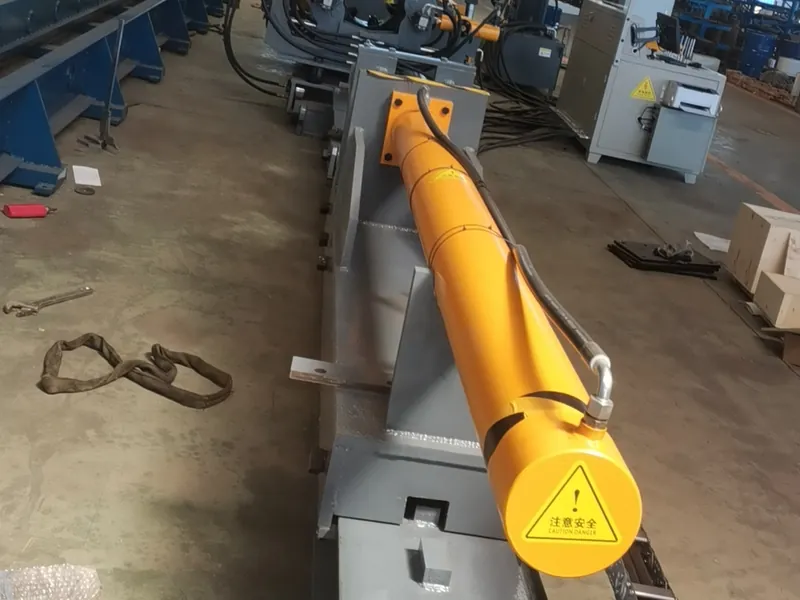
Testing a jar after assembly or repair
A drilling jar tester applies axial tension and compression to hydraulic and mechanical jars. Manufacturers and service workshops use it to check how an assembled tool releases under load before dispatch. The test directions and limits must suit the jar being tested.
The record should show the jar’s release, travel and reset behavior over the required cycles. We select the frame, hydraulic system and instruments together so they cover the intended jar sizes and the measurements called for in the service procedure.
Jar tester load, stroke and controls
Specify the release loads, useful travel and full tool dimensions first. Then decide which readings need to be captured and whether the approved procedure calls for manual or programmed cycles. The load and stroke are selected for the tools being tested.
Specifications reviewed 12 September 2026.
Release tests, fixtures and records
Upward and downward release
Compare upward release and any required downward release with the limits in the jar procedure. For hydraulic jars, record the delay and reset behavior where the test calls for them.
Repeated loading cycles
Repeated cycles let the workshop compare release values and investigate inconsistent activation. Manual or programmed control can be specified to suit the approved procedure and the number of tools being processed.
Records linked to the jar
Keep the measured results under the jar’s serial number and service reference. When specifying the software, state which curves, readings and acceptance fields you need to save or export.
Adapters and tool support
Send the jar length, connections and required movement so we can check adapters, supports and usable bed length. The installation review also covers load capacity, handling room and protective arrangements.
Jar sizes and test requirements
The proposal lists the load range, instruments and options for the supplied tester. Check those details against every jar model and test direction in your intended tool list.
| Parameter | What to consider |
|---|---|
| Axial force · kN | Tension and compression describe the force applied along the tool; specify both required loading directions. |
| Hydraulic pressure · MPa | Circuit pressure describes the hydraulic system. It is not interchangeable with calibrated jar force in kN. |
| Travel and stroke · mm | Separate available actuator travel from the jar stroke being assessed, including its reset requirement. |
| Delay time · s | For hydraulic jars, assess the response time under the load conditions defined by the tool procedure. |
| Acquisition · samples/s | Choose sensor ranges and recording rate for the required event; dynamic impact measurement needs specific validation. |
| Tool dimensions · mm | Outside diameter, overall length and connection geometry determine supports, adapters and usable test-space requirements. |
Planning the jar test
- 01
Identify the jar and procedure
Use the tool identification and service history to select the applicable test document. Confirm loading directions, required cycles and the results needed for the release decision.
- 02
Check readiness for testing
Review the inspection and assembly records. Check that the fixtures, instrument ranges and calibration status are suitable for the test.
- 03
Review the measured behavior
Compare release force, travel, delay where applicable and repeated-cycle results with the procedure limits. Investigate an unusual trace before approving the tool.
- 04
Complete the tool record
Review the test alongside the service findings. Save the decision and supporting readings under the same jar serial number.
This outlines what the workshop needs to prepare. Test settings and acceptance limits must follow the approved equipment instructions and jar procedure.
Jar tester applications
Manufacturing verification
Check assembled jars against the product test procedure and keep results for each individual tool.
Repair and refurbishment
Test jar function after inspection, repair and reassembly. Link the final result to the work carried out on that jar.
Fleet and service centers
Assess incoming jars and check tools before dispatch, using the procedure and limits for each model in the fleet.
Information to keep with each test
- Jar identity, serial number, customer reference and service record.
- The procedure and limits for each required loading direction.
- Cycle results, release force, travel and hydraulic delay where applicable.
- The recorded curves, instrument identifiers and calibration references included in the test scope.
- Operator, test date, review comments and the decision on the tool.
Jar tester questions
Does a successful test replace maintenance?
No. A test checks the behavior of the assembled tool. The workshop still needs the inspection, dimensional checks and repair records required by the service procedure.
Can one tester cover different jar types?
It can cover a range when the load capacity, tool dimensions, stroke, adapters and test functions meet each jar’s requirements. Send a list of the intended jars so we can check the full range.
What determines whether a jar passes?
The jar manufacturer’s or customer’s applicable procedure sets the acceptance limits. Release settings and permitted variation can differ between tools, so they must be confirmed for the actual model.
What information is needed for a quotation?
Send the jar types, dimensions and connections, required pull and push forces, useful stroke and cycle requirements. Include the electrical supply and the readings and reports you need.